
A poll tax by another name
How Louisiana Republicans are weakening Black political power and adding new barriers to the ballot. And how to support the effort to recall Gov. Jeff Landry.


Republican leaders in the Louisiana Legislature are not content with disenfranchising half of the state’s Black voters through a racial gerrymander. They have nearly finished eliminating one of two majority-Black congressional districts in a state that is one-third Black.
That’s all egregious enough.
And it’s being done at the direction of Donald Trump, who fears losing his majorities in Congress in the upcoming November midterm elections.
But there’s more.
Instead of changing course or reining in the corrupt authoritarianism that’s made him historically unpopular, Trump now wants Republicans across the country to rig the elections: Instead of allowing Louisiana voters to choose their representatives, he wants the representatives to choose their voters.
And those representatives want white voters—not Black voters—to have disproportionate political power and influence.
But it’s not enough that a third of the state’s population will soon have its political influence halved.
Now, Republicans at the state capitol want to make it harder and more confusing to vote at all.
Louisiana’s Republican secretary of state has reported no serious or widespread voter fraud, but that’s of no concern to Republicans in Baton Rouge. They’re not concerned about nonexistent fraud.
They’re concerned, instead, about the “wrong” type of person voting.
Here’s how the Baton Rouge Advocate describes a bill about to be passed by lawmakers:
Currently, if voters show up to the polls without a picture ID, they can sign an affidavit confirming their identity and listing their date of birth and mother’s maiden name.
Under SB319, voters will no longer have that option. Instead, to cast a ballot without a photo ID or other identifying documents, they’ll have to go to the office of the registrar of voters in that parish and cast a conditional ballot. Then, they’ll have two days to present the required photo identification for the ballot to be counted.
The bill would also limit what documents count as photo ID. Examples include a Louisiana driver’s license or ID, passport or other citizenship document that has a photo and signature and a military or tribal ID. Currently, to confirm someone’s identity, poll workers can accept a “generally recognized picture identification card that contains the name and signature of the applicant.”
If a voter doesn’t have photo ID, they’ll have the option to present a combination of two other identifying documents. At least one would have to be a “primary” document such as a birth certificate, Social Security card or certificate of citizenship. The second document could be an item like a voter registration notice, recent utility bill, bank statement or pay stub.
These new voter ID requirements will almost certainly make it harder for poor people and minorities to vote.
Many low-income voters lack government-issued photo IDs, reliable transportation to DMV offices, or the supporting documents needed to obtain identification, such as certified birth certificates or passports. Black and other minority voters are disproportionately represented among low-income Louisianans, so the burden will fall unevenly across racial and ethnic lines.
Tightening the ID rules will add yet another bureaucratic hurdle for citizens who are already eligible to vote.
Critics of voter ID laws nationwide rightly note that these measures function less as anti-fraud protections than as barriers to participation—especially given that documented cases of in-person voter impersonation are extraordinarily rare.
In practice, the people most likely to be deterred from voting are not criminals or undocumented people, but elderly, poor, rural, and minority voters—those who already face the greatest obstacles in navigating government systems.
This bill is essentially a mini-SAVE Act, legislation championed by Trump and his allies and designed to make it harder for minorities and women to vote.
It rests on the premise that everyone should have to prove who they are before they vote—and that everyone already has an ID, so they just need to show it, and the problem is solved.
But that simple-sounding premise simply does not match reality.
The piece at this link by Brandeis University student journalist Sam Wexler is worth your time. But the following passage from Wexler in The Justice, the university’s independent student newspaper, is particularly relevant to the debate over the Louisiana voter ID law. He writes:
[L]ook at the practical steps someone must go through to obtain the photo ID necessary to vote. While the statutory language [in the SAVE Act] can vary between the House-passed version and a final version [of an executive order] signed by the president, the currently specified acceptable forms of voter ID are a U.S. passport (book or card), a state-issued driver’s license, a state-issued non-driver identification card, a military identification card, a tribal government-issued photo ID, a federal government-issued photo ID, a state government-issued photo ID and a U.S. territory-issued photo ID.
Looking at this wide list of acceptable IDs, most people may think they would already have one, almost by default, if they’ve ever left the country for vacation, driven a car to work or opened a bank account.
However, as likely as that may seem, it is not the reality for millions of voting-age Americans. In actuality, as of a 2023 survey, 52% of Americans lack a passport, 29 million lack a driver’s license, and there are 5.9 million unbanked households, with 5.7% of Americans being paid in cash according to the FDIC. This is the reality many Americans live in.
A 2023 University of Maryland research study found that 7 million voting-age U.S. citizens lacked any form of non-expired government-issued photo identification. With 260 million voting-age Americans, that makes up 2.7% of the entire population. For reference, a sum of 311,257 votes across the six major battleground states won Joe Biden the 2020 election.
Let’s be clear: This Republican bill being pushed through the Legislature isn’t about making our election system safer from (non-existent) voter fraud.
It’s about protecting Republican candidates from minority voters who might support a Democrat.
Recalling Gov. Jeff Landry?

The overwhelming rejection of the five constitutional amendments on the recent statewide ballot suggests there’s a will to recall Gov. Jeff Landry, as the grassroots organization Louisiana Deserves Better is trying to do.
The group is also trying to recall Attorney General Liz Murrill and East Baton Rouge Mayor-President Sid Edwards.
I was more than a little skeptical at first about the prospects of recalling Landry. And let’s be honest, the bar is very high: Organizers must collect the verified signatures of 20 percent of the state’s 2.8 million voters by the end of October.
That’s about 580,000 signatures—probably a lot more, to be safe—in just under six months.
That high bar is why no Louisiana governor has ever been recalled.
It will be difficult to make this a reality. But, judging by the energy we’ve seen in the recall’s early days and the turnout against the amendments, there’s a chance it could happen.
But that means we must participate. We need to sign the petition, bring a friend or two, and share information about the recall with our like-minded neighbors, friends, and family.
Here’s what you and I need to know about the recall effort
To sign a recall petition, a voter must meet strict legal requirements. Louisiana does not accept online or electronic signatures for recall petitions.
Here’s the process.
You must:
1. Be a registered Louisiana voter
You must be a qualified elector registered to vote in Louisiana. If you are not registered, your signature will not count.
2. Sign an official state-approved recall form
The recall drive must use the official statewide recall form approved by the Louisiana Secretary of State, or an exact, legally compliant duplicate. Anything else is invalid.
3. Sign the form in person
Louisiana law requires handwritten signatures. There is no valid online petition system for recalling the governor. You cannot legally sign a petition on Change.org, by email, via DocuSign, through QR codes, or on social media forms.
4. Provide the required identifying information
On the petition sheet, voters generally must provide: printed name, signature, residential address, parish, and date signed. The information must match voter registration records so registrars can verify it. Sloppy or mismatched entries may be rejected during certification.
5. Sign within the legal collection period
For the current Landry recall effort, organizers have 180 days from filing to collect signatures. That’s puts the deadline around October 31.
6. Sign only once
Duplicate signatures are typically invalidated during verification.
7. Use your actual residence address
Using a mailing address, business address, or old registration address can cause the signature to be rejected.
Louisiana Deserves Better also advises signers to bring a photo ID and their voter card when signing.
Also, don’t sign any petition that isn’t organized by Louisiana Deserves Better. You can find approved sites at this link.
What happens if the organizers collect the required number of signatures?
If a recall petition against Landry gathers enough valid signatures, Louisiana law mandates a formal statewide recall election.
Here’s what happens next:
Registrars certify the signatures
Each parish registrar of voters verifies petition signatures against voter-registration records. Invalid signatures are removed. These include nonregistered voters, duplicate signatures, incomplete entries, wrong addresses, signatures outside the filing window, or unreadable/uncertain matches.Results go to the Secretary of State
Once parish registrars complete verification, the totals are transmitted to the Louisiana Secretary of State. If the required threshold is met, the Secretary of State’s office formally certifies the recall petition as sufficient.The governor is officially notified
The state then formally notifies the officeholder that the recall petition has succeeded on procedural grounds.A statewide recall election is scheduled
If enough verified signatures are collected, Louisiana law requires that a recall election be called. Voters statewide would then vote “yes” or “no” on whether to remove the governor from office before the end of the term.The recall election happens
The ballot question is, essentially:
YES = remove the governor
NO = keep the governor in office
A simple majority decides the outcome.
If the recall succeeds, the office becomes vacant
If more voters support removal than oppose it, Landry is removed from office immediately after the results are certified.The lieutenant governor becomes governor
Under the Louisiana Constitution’s succession rules, the lieutenant governor automatically assumes the governorship for the remainder of the term. There is no separate replacement election for governor after a successful recall.
Right now, that would mean Lt. Gov. Billy Nungesser would become governor if Landry were recalled.
Where can you sign?
You can find the latest schedule of times and places around the state at this link.
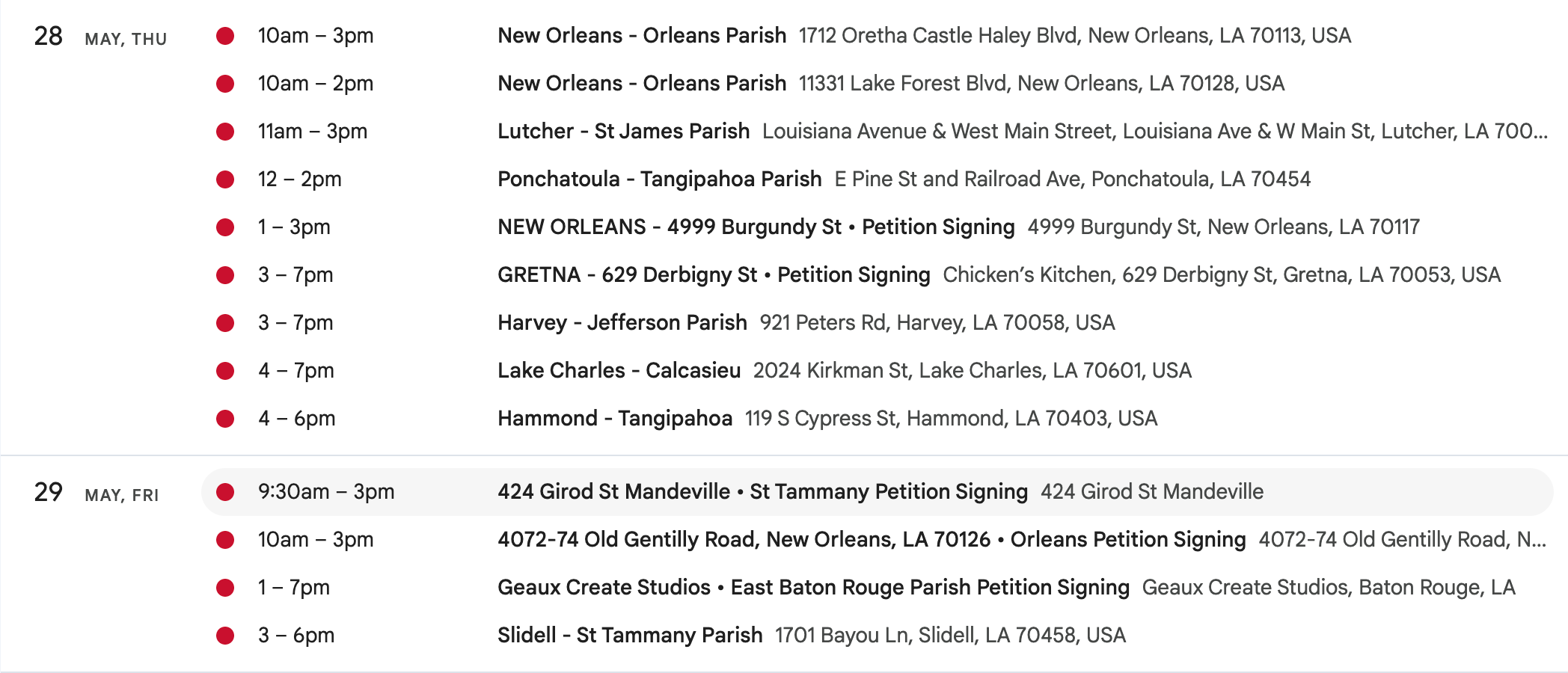
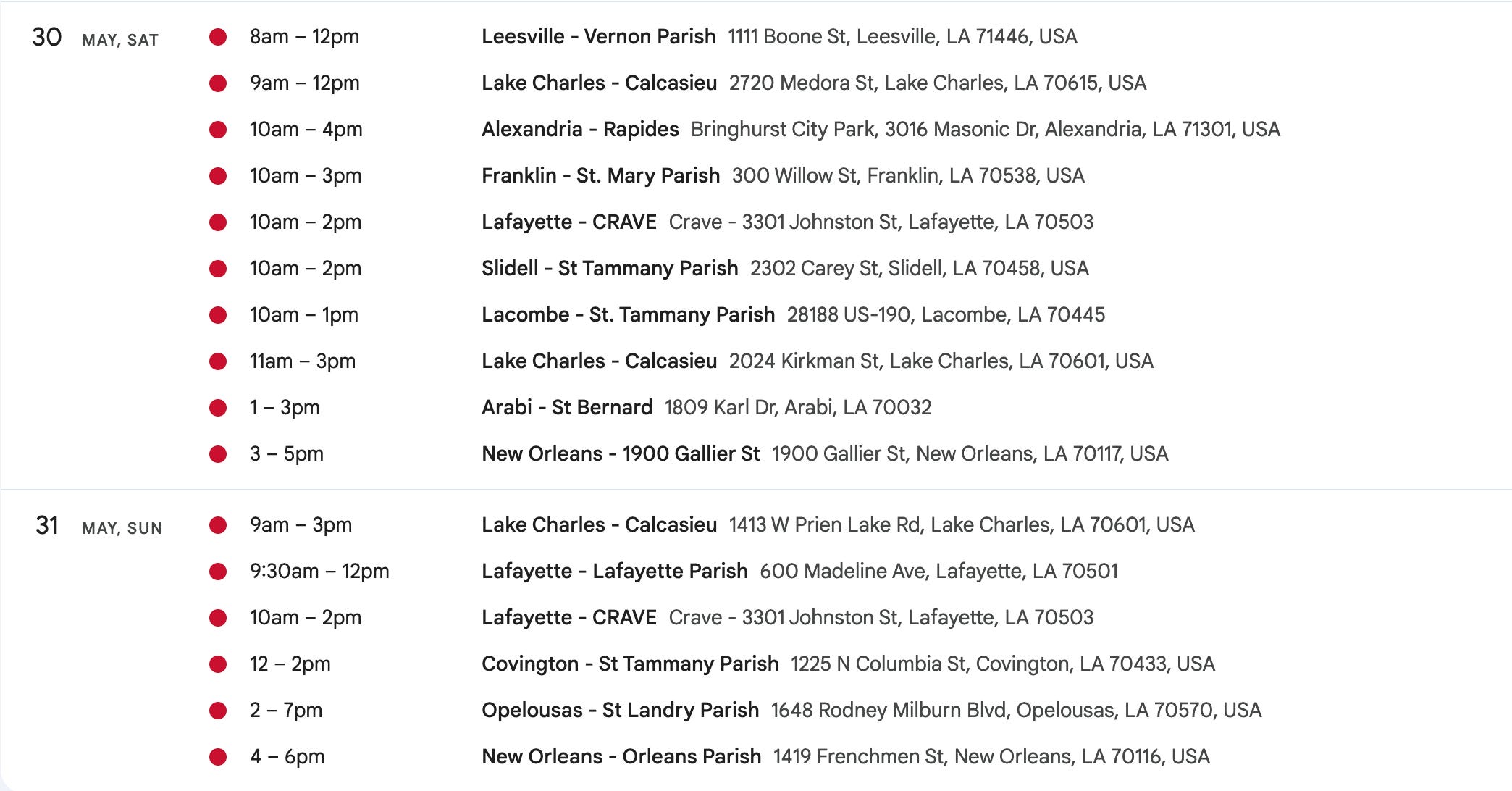
Here are the locations where organizers will be collecting signatures in the coming days.
First, the multi-day times and locations:

And here are the times and locations for sites over the next few days:
time to start gathering friends for a signing party
Well described, Bob! My solution: I see in the face of all Republican politicians that of Donald Trump. I cannot unsee it.