
Criminalizing poverty won’t solve homelessness
As Louisiana moves toward passing H.B. 211, real solutions are being ignored—here’s how we can push back with compassion, not punishment.


As legislation that criminalizes poverty and homelessness moves toward final passage in the Louisiana Senate, those of us who want to solve the problem, rather than punish people for experiencing it, need to speak out effectively.
Let’s be honest: the Senate will likely pass H.B. 211, and Gov. Jeff Landry will likely sign it.
They’ll do so for several reasons: they disregard poor people, they show little interest in building a more humane society, and they embrace policies that put more people in our state prisons because doing so benefits the private prison industry, which helps fund many of their campaigns.
Win, win, win—unless you’re homeless.
Nothing in this bill will meaningfully address the root causes of homelessness, because that is not what it is designed to do.
It is designed to fill our prisons, and if it cannot do that, it will make our cities and towns so hostile to the poorest people that they are forced to leave for another state.
Problem solved?
It does not have to be this way. Many churches and nonprofits around the state are already working on these issues. Any governor or lawmaker who cares about addressing homelessness effectively would bring those people to the table, seek their advice and insight, and draw on their experience when shaping legislation and policy.
But that is not what is happening at the state Capitol or in many cities across Louisiana. Mayors and police departments will soon begin enforcing the part of this law that criminalizes camping on public property.
And some parishes will no doubt create the Homeless Courts that Landry and his allies want, putting even more people into our prisons.
So what can we do?
First, we can make sure our mayors, state court judges, council members, and district attorneys know that we do not want homeless courts in our jurisdictions.
The bill allows Homeless Courts, but it does not require them.
Here is the language: “Each district court by rule may designate as a Homelessness Court program one or more divisions of the district court to which participants are assigned and may establish a probation program to be administered by the presiding judge or judges thereof or by an employee designated by the court.”
So let’s start reaching out to district attorneys and judges and let them know how we feel about what they may do.
The message to judges and district attorneys: “I do not want a Homeless Court in this parish. You have more than enough problems with real crime to devote our precious resources to criminalizing a problem that we should be addressing in a smarter, more compassionate way.”
Under this bill, camping on public property would generally be prohibited by local governments. However, a local governing body could temporarily allow it, for up to one year, on designated public land if:
• There are not enough homeless shelter beds available.
• The site is not next to residential areas.
• It will not harm property values, safety, or children.
Every mayor, city council, and police department will therefore have considerable discretion in how they enforce this. Make sure you let your mayor and council members know that you want compassionate enforcement of this law.
The message to local officials: “I do not want our city/parish to participate in the criminalization of homelessness and poverty. I know this is a problem we must address, but arresting and jailing poor people simply because they do not have anywhere to sleep is inhumane. Please work with local churches and nonprofits that know a lot about this problem. Partner with them and seek their guidance. They understand this issue more than you or I do.”
Churches and nonprofits are doing great work. We should listen and learn from them.
Speaking of churches doing something effective and creative about homelessness, I call your attention to a letter in Wednesday’s Baton Rouge Advocate by Rev. Garrett Boyte, rector of Holy Cross Episcopal Church in Shreveport.
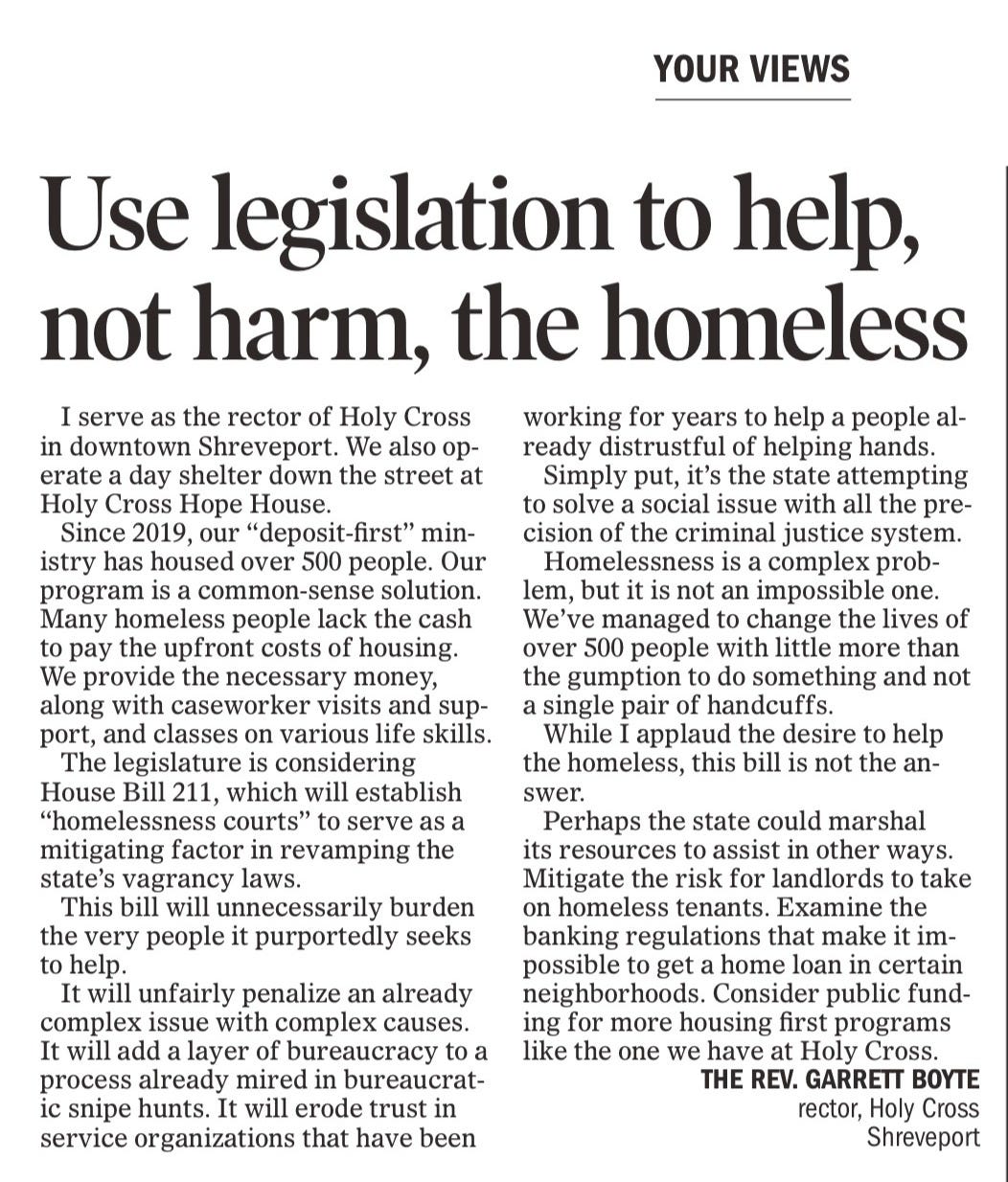
Rev. Boyte’s church runs Holy Cross Hope House.
“Since 2019,” he writes, “our ‘deposit-first ministry has housed over 500 people. Our program is a common-sense solution. Many homeless people lack the cash to pay the upfront costs of housing. We provide the necessary money, along with caseworker visits and support, and classes on various life skills.”
Regarding H.B. 211, Rev. Boyte added, “This bill will unnecessarily burden the very people it purportedly seeks to help. It will unfairly penalize an already complex issue with complex causes. It will add a layer of bureaucracy to a process already mired in bureaucratic snipe hunts. It will erode trust in service organizations that have been working for years to help a people already distrustful of helping hands. Simply put, it’s the state attempting to solve a social issue with all the precision of the criminal justice system.”
I would add to this conversation the words of my pastor, Rev. Brady Whitton of First United Methodist Church of Baton Rouge, which also operates an effective homeless ministry, the Love Your Neighbor Van. A lay leader who helps direct that ministry testified against the bill during a committee hearing last week.
Rev. Whitton recently posted his thoughts about this legislation on his Facebook page, but here’s an excerpt:
“As a pastor, I left [the committee] thinking about how easy it is for people who are poor, unhoused, or struggling to become abstractions in public debate. As Christians, we can’t let this happen. They are neighbors. They are people made in the image of God. It is up to us to speak up for them. As Proverbs 31:8 says, ‘Speak out for those who cannot speak, for the rights of all the destitute.’”
So, let’s take Rev. Whitton’s call to heart and start speaking out by phoning our local elected officials to make sure they understand how we want them to approach this bill once it becomes law.
Another way to make a difference is to find a program or ministry in your community that is doing good work and support it.
You can support the work of Holy Cross Hope House at this link, and the First United Methodist Love Your Neighbor Van at this link.
I've read the great book When We Walk By by Kevin Adler. I also met with the author. Adler changed my attitude and perception of the unhoused. And YES, there's a lot that can be accomplished with compassion over punishment.
Well, stated, Bob. As a regular participant in the Love Your Neighbor Van program I can attest that the many homeless folks I’ve met are, in fact, real people like you and me. God’s children whose only “sin” is a lack of resources that most of us consider essential. I once heard a man say, “I used to live in a $400,000 house; now I live under a $4,000,000 bridge”. It’s a situation that can happen to anyone, at any time in this turbulent age.
These folks need care and support - not demonization or condemnation. I’m going to be nagging all of my elected officials, not just my District Attorney. I’ll be contacting my council members, state legislators, and even my congressperson (if I still have one) with the message that if we continue to treat the homeless as “trash” or “criminals”, we might as well build an Ark and take our chances…