
One postcard won’t save democracy. Millions might.
It’s time to stop doom-scrolling and start writing.

If you’re angry about what Donald Trump and his enablers have done to our country, worried about the Supreme Court’s corruption, or concerned about voting rights, Medicare, Medicaid, public education, civil rights, and the basic decency of American life, here’s one small but meaningful thing you can do: sign up for Postcards to Swing States.
This initiative, run by the Progressive Turnout Project, sends volunteers free postcards, voter lists, and instructions with tested message options.
Volunteers like you and me provide the postcard stamps — currently 61 cents each. (I ordered my stamps online today at https://www.usps.com.)
We write the cards at home and mail them to voters in key states and competitive US House districts in October, ahead of the Nov. 3 midterm elections.
The fight for Congress won’t be won by television ads alone. It will be won by turnout — by personally and directly reminding Democratic and progressive independent voters that their votes are needed.
Postcards work because they are human. They arrive in a mailbox not as another piece of digital noise but as a handwritten message from one citizen to another. They signal that someone cared enough to write. Someone believes your vote matters.
The impact is real.
Postcards to Swing States began in a volunteer’s garage and has since grown into a national effort with volunteers in all 50 states, D.C., and U.S. territories. The organization reports that volunteers have sent more than 99 million handwritten messages and that its 2024 postcard program added an estimated 200,000 votes.
I’ve done it in several elections over the past two years, and I know many of you have as well.
No single postcard saves democracy. But millions of small acts can change an election.
Please consider signing up. Order your postcards. Buy your stamps. Sit at your kitchen table and help turn out voters where margins may be razor-thin.
Know when to go
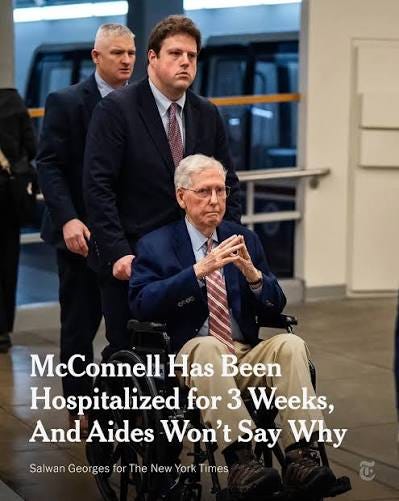
Mitch McConnell, Donald Trump, and Bill Cassidy do not have much in common temperamentally.
McConnell is reptilian and strategic. Trump is sloppy, overwrought, and grievance-driven. Cassidy has long portrayed himself as the earnest doctor-politician, the honest, reasonable man in an unreasonable party.
But all three share one fatal political flaw: they did not know when to leave gracefully.
That is not a small matter in public life. Democracies depend not only on elections, rules, and institutions but also on the character of people who recognize when their time has passed.
I’ll never forget the day in February 1985 when my then-boss, Russell Long, announced his retirement after 38 years in the U.S. Senate. Among the reasons he cited for leaving in his mid-sixties was that “people need to know when to go.”
I think he made the right call.
Just next door to our suite in the Russell Senate Office Building were Strom Thurmond of South Carolina, already ancient and mostly confused about where he was, and John Stennis of Mississippi, who was in a wheelchair and growing feebler by the day.
I’m certain Long saw both men pass by his office and vowed he’d never leave the Senate in that condition.
McConnell once had a legitimate claim to being among the most effective Senate leaders in modern history. He reshaped the federal judiciary and secured conservative victories that will endure for decades. (I know, it’s not a legacy to be proud of.)
But he’s stayed too long. The image now is not one of mastery but of decline: an aging senator (perhaps in a coma or dead as we read this) whose power has slipped away and whose long goodbye has become painful to watch.
Trump’s failure was more dangerous.
He lost the 2020 election and could have left as a defeated president, still wielding enormous influence over his party. Instead, he lied, raged, pressured local election officials, summoned a violent mob, and made loyalty to his wounded ego the defining test of Republican politics.
He didn’t merely refuse to leave gracefully. He taught millions of Americans that losing is illegitimate when their side comes up short.
Joe Biden, to his credit, finally did what Trump never could: he stepped aside. But he also waited until the choice was nearly taken from him.
Cassidy’s case is smaller yet more pathetic.
After voting to convict Trump for his role in the January 6 attack, he briefly appeared willing to pay a price for principle. But then he tried to survive in a party that had already turned on him. Rather than step aside with dignity and claim the high ground, he sought reelection from voters who had no intention of forgiving him. The result was not vindication. It was a humiliating rejection.
There is a lesson here, especially for politicians who confuse longevity with greatness: Staying too long can erase much of what came before. It can turn strength into stubbornness and service into self-preservation.
The graceful exit is underrated.
It requires humility, timing, and self-knowledge. Those are qualities American politics badly needs —qualities McConnell, Trump, and Cassidy never attempted.
Justice Guidry’s warning: No one is above the law
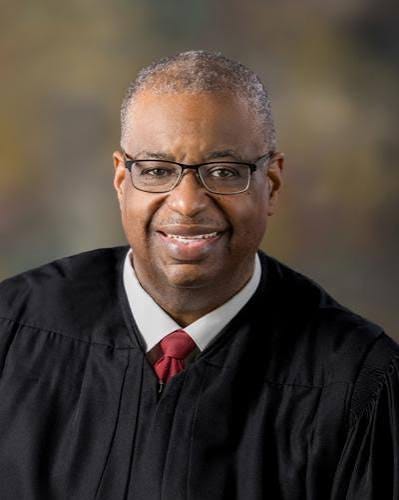
Louisiana Supreme Court Justice John Michael Guidry’s dissent in the court’s handling of Attorney General Liz Murrill’s criminal case is only two pages long. But it’s powerful and worth three minutes of your time.
Guidry wrote plainly. In his view, the court’s majority did something extraordinary — and dangerous — by rushing to give Murrill special treatment before the criminal process has had time to function.
“Without even allowing the ink to dry on the indictment,” Guidry wrote, the majority gave “preference and priority to one criminally accused citizen” over countless others, including defendants “languishing behind bars” while they wait months or years for courts to act.
I won’t try to summarize it here, because it’s brief and powerful enough that you can read it for yourself. Here it is below. The only edits I have made to it are to break up his two long paragraphs to make it a bit easier to read:
Without even allowing the ink to dry on the indictment, the majority gives preference and priority to one criminally accused citizen over all her fellow citizens who also have been criminally charged, many of whom are languishing behind bars awaiting action by lower courts, and it may take them years before they are ever granted review of their matters by this court.
There is no exigency that exists here that is not faced by every other indicted citizen. This is not supposed to be how the system works. Due process and equal protection under the law does not allow anyone to cut the line and have their matters considered more preferentially than others.
Such preferential treatment has no place under the rule of law where all individuals should stand on equal footing before the bar of justice.
As our state’s highest court, we should sincerely care about the rule of law and vigorously protect it without fear or favor. To do anything less is beneath the dignity of our state’s highest court.
This perilous and unprecedented action threatens this court’s long-term legitimacy in the eyes of the public. Can our court truly say with a straight face after today’s ruling, on the eve of the 250th anniversary of our nation’s independence, that we truly believe that no one is above the law?
Our actions should always be evidence based. Yet the majority takes this extraordinary and unprecedented action based on the applicant’s mere allegations, often couched in the legal jargon of “on information and belief,” unsupported by sworn record evidence. We have no idea what evidence was presented or what sworn testimony was given before the grand jury.
That is why this matter should be allowed to be vetted through the normal legal process. How can we even second guess that which we have not been made privy to?
Further, in a footnote in the majority opinion in Crockett v. State, 26-00594 (La. 6/1/26), ___ So. 3d ____(the decision upholding the removal of Calvin Duncan as the Criminal Clerk of Court of Orleans Parish), the majority made clear that the Orleans officials had not violated the law the attorney general wrote them about and that their action could not form the basis for any prosecution.
Now with today’s action, the majority repudiates that finding now that it seems to be at the core of the grand jury indictment.
Let me be absolutely clear, I believe every criminally accused person should be afforded the presumption of innocence and should be entitled to all the protections afforded the criminally accused under our state and federal constitutions on an equal basis before all courts, including this one.
Today, the majority’s action gives the public the perception that the scales of justice can be tilted to favor the position of one criminally accused person, but not others.
That erodes public confidence in the judiciary, undermines the rule of law, and makes a mockery of the ideal of blind justice. I cannot, in good conscience, be complicit in such a course of action and therefore, I respectfully dissent.
Thank you, Bob! I need to step up again with writing postcards; your article prompted me to get busy doing this again. Regarding Justice Guidry’s dissent, I’m going to use my free speech rights, white male privilege, and private citizen status to add another thought that I think needs to be said. Like so many other issues in Louisiana and the horrible actions of all three branches of its government, this Supreme Court decision is tinged, or even imbued (intertwined), with racism through and through! In addition to the special treatment afforded to a conservative white person in a position of power as compared to the multitudes of indicted people awaiting trial who are also predominantly Black people, Murrell’s indictment is based on the removal of a duly elected Black man from a position where an overwhelming majority of voters elected him and a majority of all voters represented by this same man are non-white people. These voters had absolutely no say in the decision by the state to remove him from office. Justice Guidry has too much class and takes his legal duties very seriously, so he probably cannot say the accusatory things I just stated. As far as I’m concerned, any bias on my part is fully justified and supported by the facts!
I have my stack of postcards sitting here on my desk! I will start writing them soon, because the mail date is Oct 16.