
The duties of a prosecutor
Our justice system is threatened by the corruption of Donald Trump and Todd Blanche. One way to recover is to take the wise advice of a federal prosecutor from the 1930s.

Let’s talk about federal prosecutors. Some have been in the news a great deal lately, mostly because they are undermining confidence in our justice system. They have also been making headlines for spectacular misconduct and for embarrassing failures to persuade grand jurors to indict people Donald Trump dislikes.
I know that most federal prosecutors—the longtime, nonpartisan attorneys who serve administrations of both parties—are still doing their jobs as best they can.
But that is the problem. Their best is often not good enough when they work for unqualified and corrupt U.S. attorneys who are more loyal to Trump than to the law.
The problem is not just the likes of Todd Blanche, Pam Bondi, and Jeanine Pirro, although they are all terrible and have done incalculable damage to Americans’ confidence in the justice system. It extends all the way down to individual districts in states like Louisiana.
Back in January, I wrote about the new Middle District U.S. attorney, Kurt Wall, after he spoke to the Baton Rouge Rotary Club. His remarks sounded more like something you would hear from a political operative than from a nonpartisan federal prosecutor.
By the way, Wall was one of the two Louisiana U.S. attorneys Sen. Bill Cassidy said he consulted last week before voting to confirm Todd Blanche as attorney general. Not surprisingly, Wall told Cassidy that the person he answered—Blanche—to would make a great attorney general.
What are the chances that a person who serves at the pleasure of the president would recommend that Cassidy support the person that president nominated? They must be astronomical odds, right?
Seriously, you would only consult someone like Wall—a MAGA prosecutor—if you were looking for an excuse to cast what you know is a terrible vote. Cassidy must want to be a well-paid lobbyist just that bad.
But I digress.
Wall is just one example of the kind of political prosecutors that Trump and Blanche have appointed.
After Trump leaves office, the next president and attorney general will have a herculean job restoring the credibility of a department that Trump and Blanche, with Cassidy’s help, have destroyed.
The same applies to the CDC, FDA, NIH, and other public health institutions that Trump has also wrecked, again with Cassidy’s assistance.
Replacing the hacks and political operatives who have replaced the thousands of nonpartisan professionals who have fled or been fired from the Justice Department (and the Department of Health and Human Services, the State Department, etc.) will take years.
I am not a lawyer, so I can’t offer much educated advice on how to do that, other than to do the opposite of what Trump has done. In fact, that’s generally excellent advice on any topic.
The next attorney general should replace all the partisans and amateurs and hire only honest, experienced, nonpartisan prosecutors. You can’t restore the Justice Department if you don’t start there.
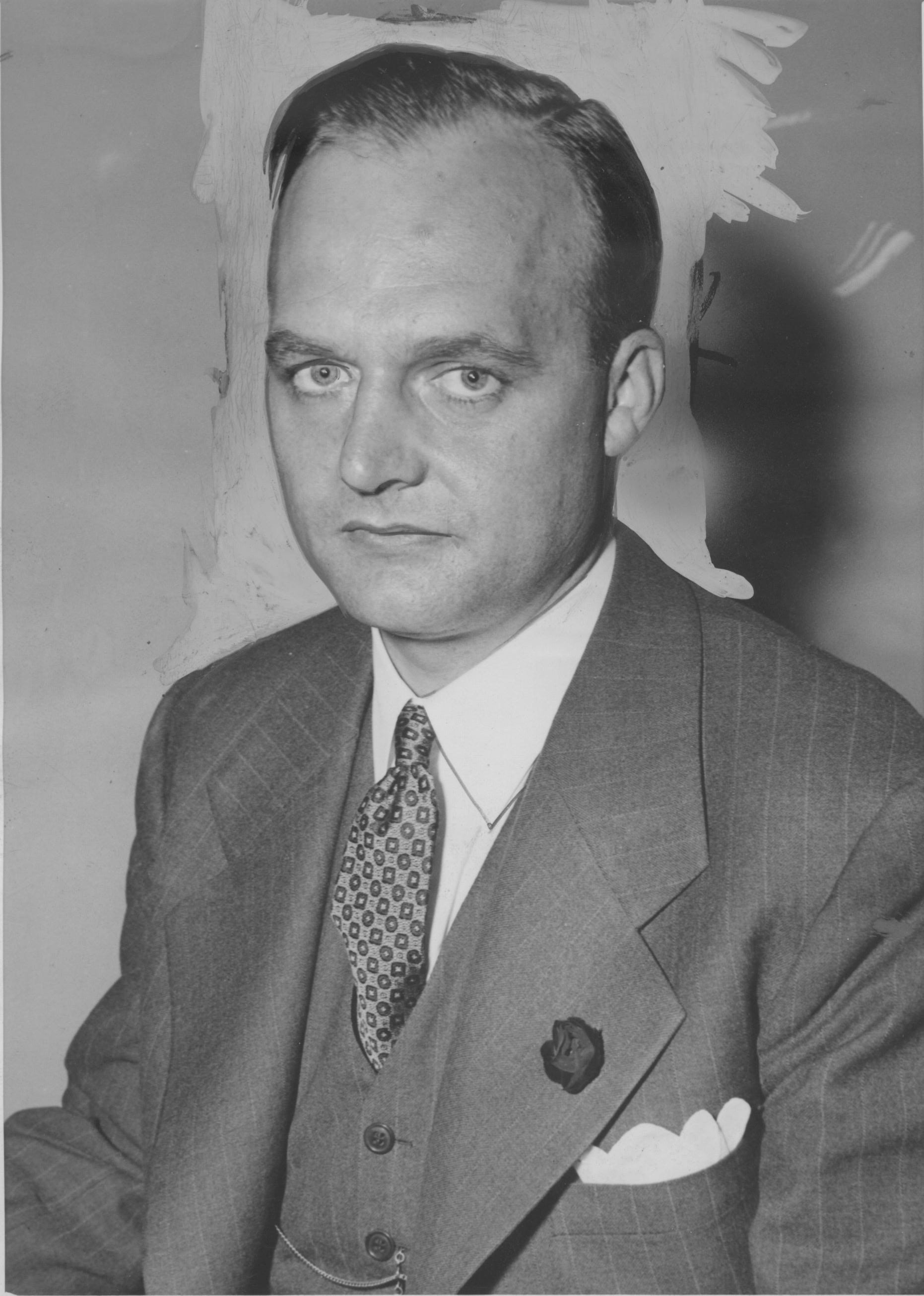
My other suggestion is that the next attorney general who cares about justice, not retribution, should consider making every person in the Justice Department read a speech that an assistant attorney general, O. John Rogge, delivered in 1939.
I came across the text during archival research for my upcoming book on the Louisiana political scandals of the 1930s.
Rogge was the head of the U.S. Justice Department’s Criminal Division, and he came to New Orleans in the summer of 1939 to lead the prosecution of Huey Long’s former associates. He put many of them in prison.
That September, Rogge went to Atlantic City to speak at the second annual conference of the judges of the Third Judicial Circuit. Rogge called his speech “The Duties of a Prosecutor” and argued that a prosecutor’s obligation is not simply to win convictions, but to protect the integrity of the justice system.
He insisted that constitutional safeguards for the accused are not obstacles to justice; they are essential to it. Because prosecutors possess extraordinary power over liberty, reputation, and criminal process, Rogge said, they must act as quasi-judicial officers rather than partisan advocates.
“The end of obtaining convictions of accused persons does not justify a prosecutor in ignoring any of their constitutional rights,” he said.
Much of his speech warned against prosecutorial overreach: manipulating grand juries, coercing witnesses, using unlawful evidence, making prejudicial arguments, and treating defendants as guilty before trial. “The inability to convict a guilty person,” he said, “is a small matter compared with the maintenance of those principles which safeguard the innocent.”
Rogge insisted that public fear, political pressure, or the desire to punish wrongdoing can never justify ignoring legal restraints. He argued that the true danger lies not only in a single abusive prosecution, but also in weakening safeguards in ways that invite broader abuses later.
Rogge ended his speech by stressing that prosecutors may be vigorous and zealous while still respecting constitutional rights. For Rogge, justice required restraint, fairness, and fidelity to law—even when those principles make conviction more difficult.
“He may prosecute with earnestness and vigor—indeed, he should do so,” Rogge said of prosecutors. “But, while he may strike hard blows, he is not at liberty to strike foul ones.”
Rogge’s approach to his department’s work would seem alien to many people in leadership roles at the U.S. Justice Department today. For now, the best bulwark against the abuses that Trump and Blanche seem to favor is federal judges still dedicated to upholding the Constitution.
Ultimately, what we need are more federal prosecutors to approach their job with the kind of sound judgment and nonpartisan sobriety that Rogge spoke about in 1939. That spirit is sorely missing today.
You’ll find the text of Rogge’s speech below.
The Duties of a Prosecutor
By O. John Rogge
September 22, 1939
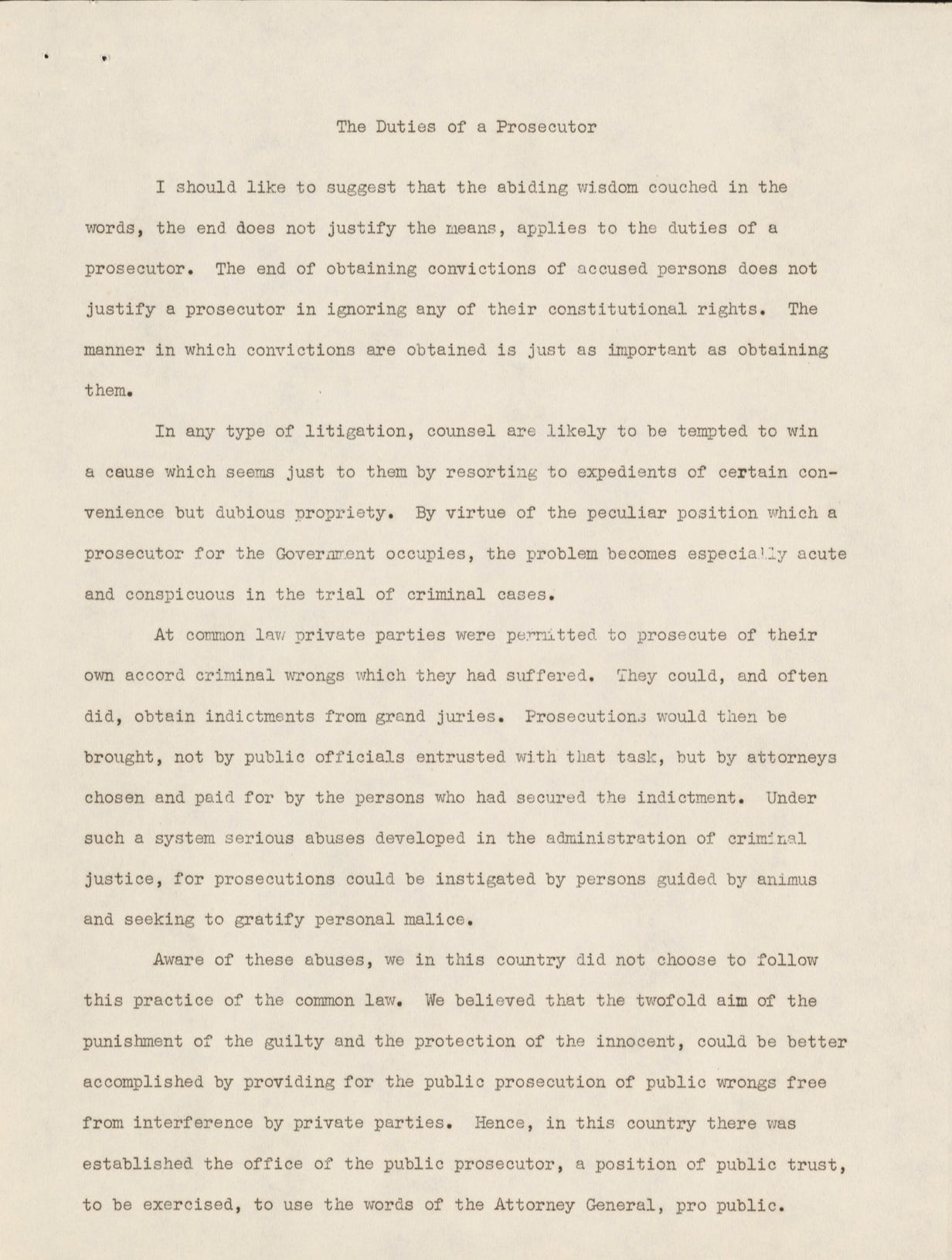
I should like to suggest that the abiding wisdom couched in the words, the end does not justify the means, applies to the duties of a prosecutor. The end of obtaining convictions of accused persons does not justify a prosecutor in ignoring any of their constitutional rights. The manner in which convictions are obtained is just as important as obtaining them.
In any type of litigation, counsel are likely to be tempted to win a cause which seems just to them by resorting to expedients of certain convenience but dubious propriety. By virtue of the peculiar position which a prosecutor for the Government occupies, the problem becomes especially acute and conspicuous in the trial of criminal cases.
At common law private parties were permitted to prosecute of their own accord criminal wrongs which they had suffered. They could, and often did, obtain indictments from grand juries. Prosecutions would then be brought, not by public officials entrusted with that task, but by attorneys chosen and paid for by the persons who had secured the indictment. Under such a system, serious abuses developed in the administration of criminal justice, for prosecutions could be instigated by persons guided by animus and seeking to gratify personal malice.
Aware of these abuses, we in this country did not choose to follow this practice of the common law. We believed that the twofold aim of the punishment of the guilty and the protection of the innocent could be better accomplished by providing for the public prosecution of public wrongs free from interference by private parties. Hence, in this country there was established the office of the public prosecutor, a position of public trust, to be exercised, to use the words of the Attorney General, pro public.
The prosecutor was entrusted with extensive power, affecting to a high degree the liberty of the individual, the safety of the community and the good of society. He was not only empowered to file an information and to appear before the grand jury, but he was permitted to enter a nolle prosequi on his official responsibility without the intervention of the Court. Such authority in one without official status would have involved an unwarranted and dangerous delegation of power. Apparently, however, because the prosecutor was regarded as a quasi-judicial officer, standing between the people and the accused, and acting not as counsel for any particular person or political party, but as an assistant to the court in administering and promoting justice, the grant of these powers was made and justified.
So intense was the interest of the people in securing a democratic and impartial administration of criminal law, so deep was their desire to erect safeguards against the abuses of an official power unconfined by the written word, that they wrote into the Bill of Rights constitutional safeguards for the accused. You are, of course, familiar with them, but I nevertheless think it well to refer to those I deem especially applicable to this discussion. These are that unreasonable searches and seizures shall not be allowed, that the accused shall not be compelled to be a witness against himself, that he shall have the right to a speedy and public trial by an impartial jury, that he shall be informed of the nature and cause of the accusation, that he shall be confronted with witnesses against himself, that he shall have assistance of counsel for his defense and that he shall not be deprived of life and liberty without due process of law.
I take it to be clear that these provisions of the Bill of Rights were drafted for the benefit of the accused and not for the accuser. The drafters of them knew that criminal prosecutions had become weapons of offense and defense in political and economic conflicts; they were aware of the perverse nature of a prosecutor when he subordinates the public welfare to his private interests and advantages; and they were desirous of tempering his powers and extending the rights of the accused, rights which no prosecutor may cavalierly waive or conveniently ignore in the belief that in securing a conviction by any means he is best promoting the good of the community. The precautionary principles of the Constitution reflect the apprehensive mood of a free people concerned with preserving their rights and privileges by erecting safeguards, not only for persons above suspicion but for those who are suspect and who mayhap stand in greater need of them. Consequently, a prosecutor who fails to respect the rights granted the accused by the Constitution flinches from his exacting duties as an officer of the Court and violates one of the principles upon which a democracy rests.
There are people who feel that when a community is beset by disdain for authority and disregard of law, sympathy should not be wasted on offenders of law and officers should not be hampered by solicitude for the rights of an accused. This attitude, it seems to me, involves a confusion of the issues, for no system of proof has yet been devised which will permit a determination of guilt without going through the traditional procedure of taking evidence according to established rules.
To deny to an accused his rights on the assumption that he is a criminal is to assume the very issues which the prosecutor must prove, that is, that the accused is a criminal. But my objection to this attitude goes deeper, for my anxiety over any violations of an accused’s rights results not from any tenderness for the law breakers but from a fear that any relaxation of the restraints imposed by the Bill of Rights because of the exigencies of that particular case may tend to a permanent weakening of those inhibitions which history demands should be imposed on the prosecutor and may reduce our resistance to later relaxation in more far reaching situations.
Nor are the stratagems and schemes which are resorted to by public officers inordinately intent upon securing convictions the less ominous because they are rationalized in terms of the public welfare and the necessity of disposing of public enemies, for those are the explanations employed by oppressors, and those are the explanations that will be employed by the ambitious oppressors of tomorrow. The Attorney General gave timely warning in cautioning us to “Be on guard against those tendencies and attitudes in ourselves as well as others, that open the door to one denial of liberty and then another.”
In my administration of the Criminal Division of the Department of Justice I hope to leave no room for contention that we were lenient to criminals or lax with law breakers, but at the same time I hope to remain responsive to the rights of those accused of crime, not because I harbor any compassion for them but because of my faith in the principles and purposes of the Bill of Rights.
Having indicated to you my attitude on the position of a prosecutor in our legal system, I should now like to mention some of the more recurrent instances in which the improvident enthusiasm of a prosecutor may cause him to forget or to disregard the quasi-judicial nature of his office and which may lead him to pursue convictions without regard to infringement of established rights.
I have in mind first the various abuses to which the Grand Jury procedure has been subjected. The Grand Jury was originally regarded as a safeguard to protect a person against public clamor, private malice, and the oppression of the Crown. Under the control of an insensitive or unscrupulous prosecutor, however, it can itself become an instrument of oppression. When the mere filing of an indictment or even the announcement that the Grand Jury is investigating a person’s affairs bears an innuendo that may seriously harm an innocent person in the eyes of his neighbors, it becomes extremely important that the public prosecutor conduct himself toward the Grand Jury with sincere regard for his responsibilities as a public trustee.
The prosecutor must always remember that his duty is to assist the Grand Jury and not to control it. Fortunately, the efforts of prosecutors to substitute themselves for the Grand Jury are but few. Probably the most notorious attempt was that in United States v. Wells. There the District Attorney gave the Grand Jury a list of the defendants and commented on the weight of the evidence. Before the indictment was signed, he was requested to leave the room by one of the jurors so that there could be a discussion. The prosecutor refused to go, asserting that he would permit no discussion until the indictment was signed. He thereupon directed the foreman to sign the indictment without permitting further consideration of it. This conduct on the part of the prosecutor before the Grand Jury induced the court to hold the indictment bad.
We should likewise disapprove of the employment of a Grand Jury in a general John Doe inquiry for the purpose of getting enough evidence on a witness to cause him to testify, not in accordance with the truth, but in accordance with the prosecutor’s wishes; or the serving of a Grand Jury subpoena upon a person day after day without any intention of bringing him before the Grand Jury, until he finally is ready to provide the testimony which the prosecutor desires; or the writing of allegations into an indictment which are not based upon evidence before the Grand Jury and which do not warrant a conviction by a petit jury; or the use of an indictment for the purpose of practicing coercion.
Shabby tactics may be used by the prosecution outside the Grand Jury room and before entering the Court Room. A prosecutor is not empowered to subpoena a person to his office for private interrogation. In order to circumvent this law, some prosecutors have printed anomalous “request subpoenas” which simulate subpoenas issued by the Court or Clerk of the Court. These prosecutors hope that through such veiled coercion they may be able to induce the uninitiated to come to their offices and make extrajudicial statements which they would not otherwise make. Since the layman customarily views such simulations as court orders, I feel that such practices are unjustified.
In the actual trial of the case, the prosecution soon finds opportunities of creating a prejudicial atmosphere. In the recent case of Minker v. United States, Judge Thompson of the Circuit Court of Appeals for the Third Circuit, severely criticised the opening statement of a prosecuting attorney because it was saturated “with the personal views of the prosecuting attorney, with insinuations as to his personal knowledge of circumstances surrounding the case and as to the unique position of the Government entitling it to a conviction following indictment.”
Nor should the prosecutor in his opening argument make any attempt to conceal the position of the Government or misrepresent the facts which are to be the foundation of the conviction. Since our law does not permit discovery in criminal cases, the prosecutor should be completely frank and fair with the defendant.
The use of evidence obtained through unlawful search and seizure has been the subject of such severe and repeated criticism that I shall do no more than declare my own belief in the merits of such criticism.
Probably the greatest temptation confronting prosecutors is to indulge in tactics which are, unfortunately, frequently used by defense attorneys; for example, attempting surreptitiously to introduce evidence not legally admissible. Time and again, appellate courts have rebuked prosecutors for asking obviously objectionable questions, which, even though they are unanswered, suggest to the jury prejudicial information which could not be directly proved.
In the case of People v. Wells, a defendant was being tried upon forgery charges. The prosecutor attempted to get into evidence testimony which he evidently thought so prejudicial that in his question he cautioned the witness not to answer until opposing counsel had opportunity to object. In criticising the prosecutor for the interrogation of witnesses on topics, which all attorneys know to be clearly inadmissible, the court used this very pertinent language: “It is too much the habit of prosecuting officers to assume beforehand that a defendant is guilty, and then expect to have the established rules of evidence twisted and all the features of a fair trial distorted, in order to secure a conviction. If a defendant cannot be fairly convicted, he should not be convicted at all; and to hold otherwise would be to provide ways and means for the conviction of the innocent.”
Not infrequently the prosecutor will attempt to secure the introduction of evidence of a defendant’s separate and distinct offenses, despite the settled rule that in the trial of one cause, proof of separate offenses may not be introduced.
Equally open to criticism are the over-reaching efforts of counsel to bully, confuse and frighten witnesses. In the now famous Berger case, Justice Sutherland wrote a scathing criticism of a prosecutor who misstated facts in cross-examination of witnesses, suggested by his questions that statements had been made to him personally out of court, in respect to which no proof was offered; pretended to understand that a witness had said something which he had not in fact said; assumed prejudicial facts not in evidence; and put into the mouths of witnesses things which they had not said.
In the closing argument as in the opening, the prosecutor may stoop to convict by appeals to fears, passions and prejudices of the jury. Prosecutors have been known to threaten a jury that if they acquitted they would be afraid to go out on the street to meet their fellowmen, but few have gone as far as the Arkansas prosecutor who misstated the law of Mississippi and then threatened to encourage the entire community to take the law in its own hands if the jury did not return a verdict of guilty.
This prosecutor said: “The law in Mississippi on this subject is that the relatives of the young woman who is seduced take shotguns and go out and kill the seducer. Personally, I think that is a good law. I would not blame the young men in this country when their sisters are seduced if they were to take pistols and go out and kill the seducer. If you do not enforce the statutes and convict the men charged with seduction the time will come here in Arkansas when the men will take the law in their own hands and go out and kill the seducers of their mothers, their sisters, their wives and their daughters.”
The prosecutor must of course make no attempt to confuse or mislead the jury by improper insinuations or unwarranted assertions. The prosecutor before the petit jury, as in every other relation, should depend upon the merits of his case and not upon an abusive or critical characterization of the defendant or his counsel.
A great deal has been said about legal loopholes which permit the guilty to escape. If any of the legal safeguards which were built to protect the accused have lost their usefulness and are not justified by experience, the course to take is to seek new legislation rather than to ignore or circumvent the existing law. At the suggestion of Federal prosecutors, the Department of Justice has from time to time sponsored legislation in the hope of improving our criminal procedure.
Some of these bills are now awaiting consideration by Congress. One seeks to create public defenders in United States Courts; another seeks to regulate the defense of alibi by requiring the defendant, within ten days after arraignment, to file notice of such defense with the Clerk of Court specifying the place at which he claims to have been at the time of the alleged offense; another seeks to give to the Supreme Court of the United States authority to prescribe rules of pleading, practice, and procedure with respect to criminal cases prior to and including verdict or plea of guilty; another seeks to give the defendant a right to appeal from the sentence on the ground that it is excessive; while still another seeks to give to the prosecutor a right to comment upon the defendant’s failure to testify in his case.
If these proposals are adopted, we believe the administration of justice will be improved. Until Congress acts, however, the officers of the Department of Justice will show their respect for our democratic institutions by scrupulously observing the rules of law now in effect.
The Department of Justice, however, asks more of its officers than mere compliance with the law. It asks them to bear constantly in mind the quasi-judicial nature of their office and to consider the accused as persons still protected by constitutional safeguards rather than their prey. When the prosecutor accepts his public trust, he must sacrifice pride of professional success as measured by court victories to the service of justice. The inability to convict a guilty person is a small matter compared with the maintenance of those principles which safeguard the innocent. We can still profitably refer to the dictum of Blackstone to the effect that it is better that ten guilty persons escape than that one innocent suffer.
In a democracy no end in the administration of the criminal law can justify any means which tend to invade the constitutional and legal rights of the accused. As Justice Sutherland once cogently said:
“The United States Attorney is the representative not of an ordinary party to a controversy, but of a sovereignty whose obligation to govern impartially is as compelling as its obligation to govern at all; and whose interest, therefore, in a criminal prosecution is not that it shall win a case, but that justice shall be done..... He may prosecute with earnestness and vigor -- indeed, he should do so. But, while he may strike hard blows, he is not at liberty to strike foul ones. It is as much his duty to refrain from improper methods calculated to produce a wrongful conviction as it is to use every legitimate means to bring about a just one.”
Although our philosophies may vary, I am as inspired by that language as the justice who wrote it.
I recognize that one of the consequences of participating in a contested case is the development of faith in one’s cause and zeal in its prosecution, and this faith and this zeal can do no harm so long as they are kept within the bounds of constitutional limitations. One may prosecute ardently and even zealously and yet have a scrupulous regard for the constitutional rights of the accused. The two qualities are not at all inconsistent. The end of obtaining convictions of those accused could never justify the use of unfair means, the use of means which involve any disregard of the constitutional rights of the accused.
What a timely and needed speech from Rogge that the end never justifies the means! Compare it to Trump and Cassidy’s “Alice in Wonderland” philosophy at the Justice Department under Blanche.
thank you for the message and the speech, Judge after Judge around the land is discovering, in a way that seems shocking to many of them, that the assumption that attorneys for the Justice Department do not consider themselves, nor act like quasi-judicial officers. Judges are having to demand papers and various forms of proof to take assertions of Trump's judicial minions as valid. This is far more important than may be realized by those outside the legal system, and the rule of law is going to be wounded for years to come. Like more norms, this is a significant part of where the rubber hits the road in the function of law, especially in court, and beyond federal courts.