
US Senator Jamie Davis?
A few reasons why I think the Louisiana Democratic nominee could make it a real race.

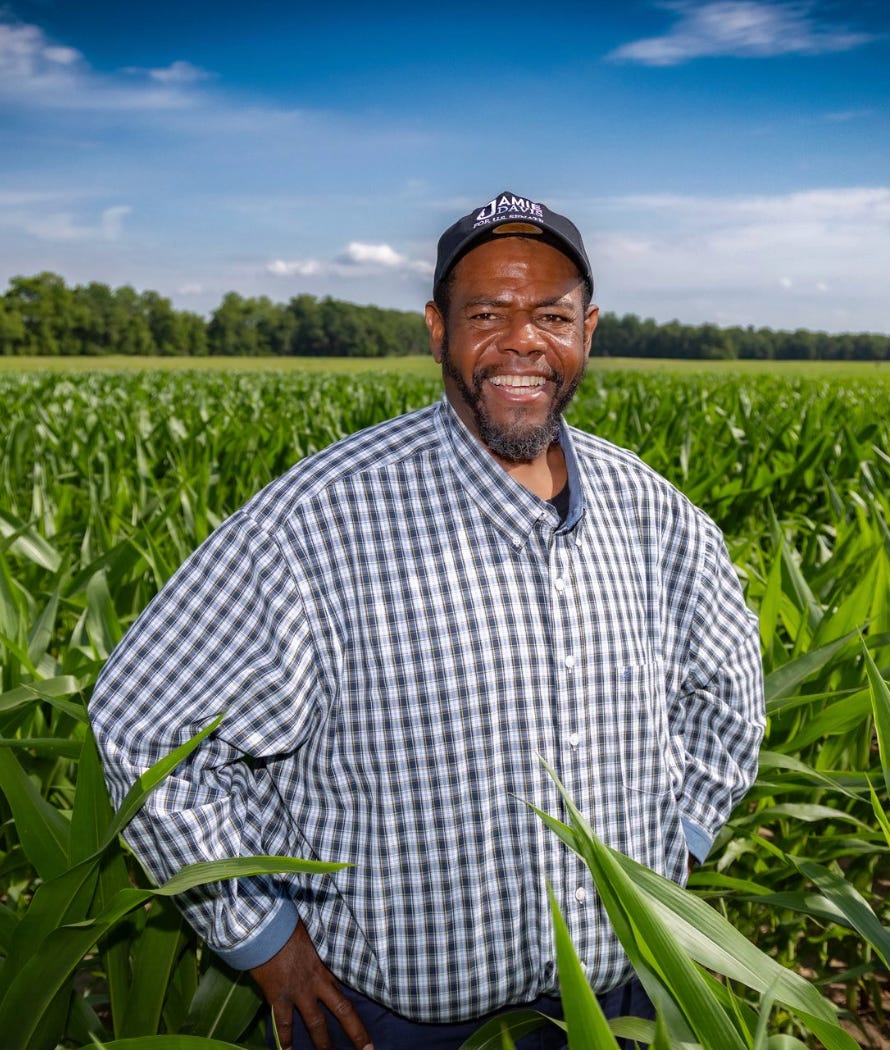
It ought to be considered a real race.
As the first Black candidate to win a major-party nomination in Louisiana since Reconstruction, Democratic U.S. Senate nominee Jamie Davis should be treated as a legitimate candidate in the November midterm election.
Some may scoff at that because of his race and his lack of money or political experience, and those might become disadvantages.
But with the right campaign and a modest amount of funding, Davis could mount a competitive race against GOP US Senate nominee Julia Letlow.
Here’s why:
Louisiana has one of the highest percentages of Black voters in the country. At 32 percent of registered voters, we are just behind Mississippi (35 percent) and nearly tied with Maryland (both at 32 percent).
Davis can be competitive with a strong Black turnout in New Orleans, Baton Rouge, Shreveport, Monroe, Alexandria, Lake Charles, and the River Parishes.
But Black turnout alone is not enough.
He needs the 15 to 20 percent of white voters who typically vote Democratic. He must also capture 5 to 10 percent of white voters who usually vote Republican but are reachable on rural healthcare/hospitals, property rights, Social Security/Medicare, tariffs, inflation, insurance, and corporate giveaways.
Winning over 20 to 25 percent of white voters is possible with a moderate level of spending and the right issues.
If Davis can get 35 of his points from Black turnout, he needs about 20 to 25 percent of the white vote to reach 50 percent.
In this environment, that’s not hard to imagine. In 2020, Georgia Sen. Raphael Warnock showed us how it’s done.
Trump, as an issue, is a double-edged sword for Letlow. Sure, Trump’s still popular here. He won the state by more than 20 points in 2024, but he’s also as unpopular here as he’s ever been. His ability to carry Letlow to the nomination in a low-turnout GOP primary is not the same as carrying her to victory in a higher-turnout midterm contest.
I’m torn about whether it’s in Letlow’s or Davis’s interest to nationalize this election.
Normally, I’d say Letlow would benefit most from such a contest, but with Trump growing increasingly unpopular and voters souring on his handling of the war in Iran, inflation, and the overall economy, making the election a referendum on Trump -- at least among Black voters -- might be a good idea for Davis.
Letlow has pledged to work in lockstep with Trump. She also absurdly calls him “the greatest president this country has ever had.” That will help her consolidate support among Republicans, but it also gives Davis a simple, effective contrast message: “Louisiana needs a senator, not a rubber stamp.”
The GOP primary exposed fissures that Davis can exploit. State Treasurer John Fleming attacked Letlow from the right on carbon capture, and carbon capture has become a real rural property rights issue in parts of Louisiana.
If Davis can speak to landowners, farmers, and rural conservatives who distrust big energy companies, pipelines, subsidies, and massive corporate state-subsidized deals, he might make some Republicans pause before voting automatically for Letlow.
Could Davis be a Black John Bel Edwards? When Edwards beat David Vitter in 2015, he did so because he was virtually unique among prominent Democrats in Louisiana: pro-life, pro-gun, a military veteran, from a law-enforcement family member, and with rural bona fides. That helped him with rural whites and others less inclined to vote for a Democrat.
Davis is also special in many ways that could help him get moderate whites to take him seriously.
He’s not a nationalized cable-news Democrat, nor is he a product of the Louisiana political class. He’s a northeast Louisiana crop farmer and a former Tensas Parish Police Jury member.
That gives him a chance to speak credibly to rural voters about healthcare (especially rural hospitals), education, insurance, energy projects, and affordability and food prices.
Davis is already framing the race around health care, education, affordability, and constitutional norms, calling them “kitchen-table, parish-level, no-corporate-PAC issues.”
That’s the right approach.
He doesn’t have to win rural Louisiana. He has to lose it less badly.
That means parish-by-parish organizing in the Delta, Acadiana, southwest Louisiana, and the Florida Parishes: courthouse and farm events, community meetings, visits to Black and white churches, and interviews on local radio and in local newspapers.
All that’s possible if he spends the right amount on a local organizing operation.
His lack of money may not be as crippling if he can maximize his fundraising to support get-out-the-vote efforts among Black voters and others inclined to support Democrats. I’m not going to try to tell you that having loads of campaign cash is overrated. You’d rather have $10 million vs $1 million every day. But having lots of cash also allows campaigns to throw money at TV and sometimes doesn’t require them to make smart, targeted spending decisions.
The dirty secret of big statewide campaigns is that much of the money spent on TV ads is wasted. You’re reaching people who are already going to vote for you or have decided they will never vote for you. You’re really spending millions to reach the small 5 to 10 percent in the middle who are still persuadable.
A leaner campaign can’t afford to communicate that way. It must target the smaller set of voters it believes it can motivate or persuade. Davis and national Democrats generally know who those voters are in Louisiana.
The fact remains that Letlow has outraised Davis by a wide margin — $5.3 million to $1.2 million from Jan. 1 to early June — but now that Davis is the Democratic nominee, the DNC, the Senate campaign committee, and Democratic PACs may be persuaded to send some seed money his way for ads and GOTV. If he starts polling well, they might send him even more.
That won’t make Louisiana easy by any stretch, but it will ensure Davis is not invisible to voters.
My sense is that this race can become competitive, but only if Davis reframes it as a Louisiana accountability race rather than a standard D-versus-R contest.
If it becomes a national partisan referendum, Letlow likely has the advantage. However, if it becomes “who is on your side when hospitals close, insurance premiums spike, land gets taken, and Washington ignores Louisiana,” Davis has a fighting chance to make it a real race.
I particularly like your final point. It also wouldn't hurt if he could get the message out that he can't be bought. The Democratic party needs to get full force behind him, but not make it Dems vs. Repubs, but rather what is good for our country and our state - the party has let us down in the past and I am holding on to membership by a thread. I hope Davis has a shot and will definitely vote for him. He will be a true citizen legislator who understands our needs. As Nancy Noone Broussard's comment emphasizes WE HAVE TO VOTE. Giving up, as too many seem to have done, is NOT the answer to our problems.
Turnout, turnout, turnout!!